How to Test an AI-Generated App Without Building a Test Framework
 Zeshi Du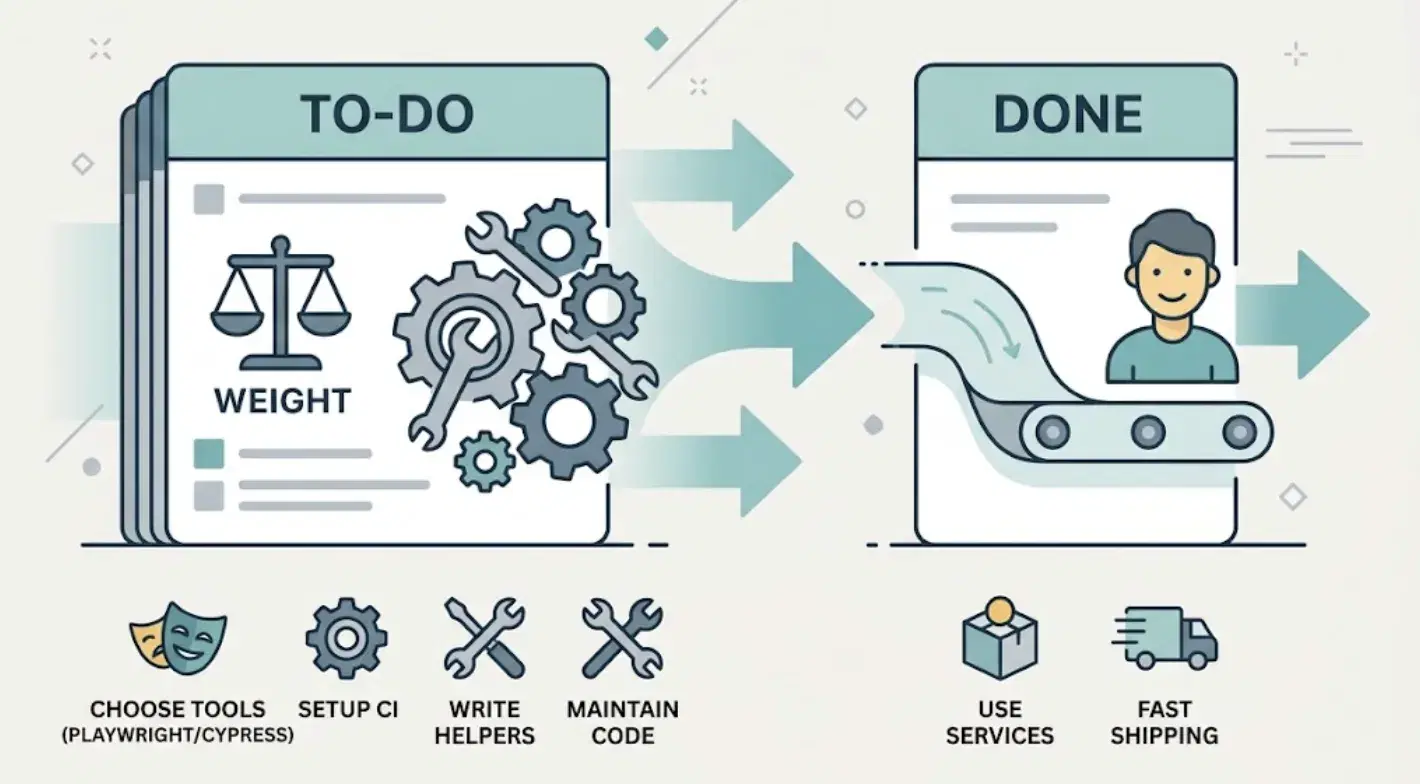
Building a test framework is itself a project: choosing Playwright or Cypress, setting up CI, writing helper functions for common flows, and maintaining all of it as the app changes. If you're a solo developer or a small team shipping fast with an AI coding agent, that project competes directly with the project you're actually trying to ship. Here's how to skip it without skipping testing altogether.
Why "build a framework first" doesn't fit AI-native development
The traditional path is: pick a framework, write a config, script your first few tests by hand to establish patterns, then keep extending that suite as the app grows. That approach assumes someone has the time to do the initial setup and the ongoing maintenance. On a team where AI is generating code 5 to 10 times faster than a person could write it manually, that assumption breaks. The framework doesn't fail; there's simply nobody available to build and maintain it while also reviewing and shipping AI-generated features.
The result, in practice, is usually one of two outcomes: the framework never gets built because there's never a good time to start, or it gets built once and then decays as nobody keeps it in sync with a fast-changing app.
What "testing without a framework" actually means
It doesn't mean testing less rigorously. It means the layer that decides what to test, generates the test code, and keeps it current is handled by something other than a person sitting down to write Playwright scripts. That's the specific role an autonomous testing agent plays.
The practical steps
1. Point the agent at your product intent, not at a test file. Instead of starting with "what should my first test look like," start with what your product is supposed to do. If you have a PRD, even an informal one, that's the input. If you don't, an agent like TestSprite can infer intent directly from your codebase, scanning your project structure, routes, and components to build a normalized internal PRD on its own.
2. Let generation happen from that intent, not from a blank test file. Rather than opening an empty .spec.ts file and deciding what to script, the agent generates end-to-end test cases covering UI flows, backend APIs, authentication, error handling, and edge cases directly from the inferred or provided intent. You're reviewing generated coverage, not authoring it from scratch.
3. Run execution somewhere that doesn't require your own infrastructure. A framework you build yourself needs a place to run: your local machine, or a CI environment you configure. An agent-based approach runs tests in an isolated cloud sandbox that spins up and tears down automatically, so there's no local browser setup or CI configuration step to build before you can start.
4. Treat failures as fixes-in-progress, not just reports. A framework you build yourself gives you a red X and a stack trace; figuring out the fix is on you. An agent-based approach can package the failure, root cause, and a suggested fix into a format your coding agent can act on directly, closing the loop rather than handing you a diagnosis to solve alone.
5. Let coverage evolve with the app instead of maintaining it by hand. As your AI-generated app changes, a hand-built suite needs someone to update selectors and assertions. A PRD-driven agent regenerates or adapts coverage as the underlying intent or implementation shifts, which removes the maintenance burden that usually kills self-built suites within a few months.
What you still need to do yourself
Skipping the framework-building step doesn't mean zero involvement. You still need to make sure your app is actually running somewhere reachable (locally, on staging, or a preview deployment), provide test credentials if your app requires login, and periodically review the generated test plan to confirm it's covering what you actually care about. Those are review tasks, not authoring tasks, and they take minutes rather than the days or weeks a framework setup typically requires.
A realistic example
A solo developer building a SaaS product with Cursor, with no formal test suite and a habit of manually clicking through the app before each deploy, connects an MCP-native testing agent to their IDE and points it at their staging environment. One instruction ("help me test this project") triggers exploration agents that navigate the signup flow, onboarding, dashboard, settings, and billing sections on their own, mapping out what exists before generating tests against it. No Playwright config, no CI YAML file, no decision about which framework to learn first.
When you might still want a framework eventually
If your team grows into having a dedicated QA function, a hand-maintained framework-based suite can make sense again, since a person is now available to own it, and there are cases (highly specific, deeply custom test logic) where a maintained framework suite gives you more granular control than a generated one. That's a "later" decision, though, not a blocker to testing your AI-generated app today.
What changes about code review once this is in place
A side effect worth noting: once generated test coverage exists for a feature, reviewing an AI coding agent's pull request changes shape slightly. Instead of trying to mentally simulate every edge case while reading a diff, you can lean on the generated test results to tell you whether the edge cases you'd have worried about actually hold up, and spend your own review attention on the things a test can't easily check: naming, structure, and whether the approach itself makes sense for where the product is going. That's a better use of a solo developer's limited review time than trying to be both the code reviewer and the entire QA function in the same pass.
What this looks like a few months in
The workflow described above tends to compound in a useful way over time. Each feature you ship generates test coverage that persists and gets re-run on future changes, so the total coverage of your app grows alongside the app itself, without you ever having sat down to plan or write a comprehensive suite. A few months into this pattern, a project that started with zero tests can end up with meaningful frontend and backend coverage across most of its core flows, built entirely as a byproduct of normal, ongoing development rather than as a separate testing initiative someone had to prioritize and schedule.
Conclusion
Testing an AI-generated app doesn't require building the traditional infrastructure first. Point an agent at what your product is supposed to do, let it generate and run the coverage, and review the results rather than authoring them. TestSprite's free plan is a reasonable way to try this workflow on your actual project without committing to a framework decision first.