How to Turn a Product Requirements Document Into Executable Tests Automatically
 Zeshi Du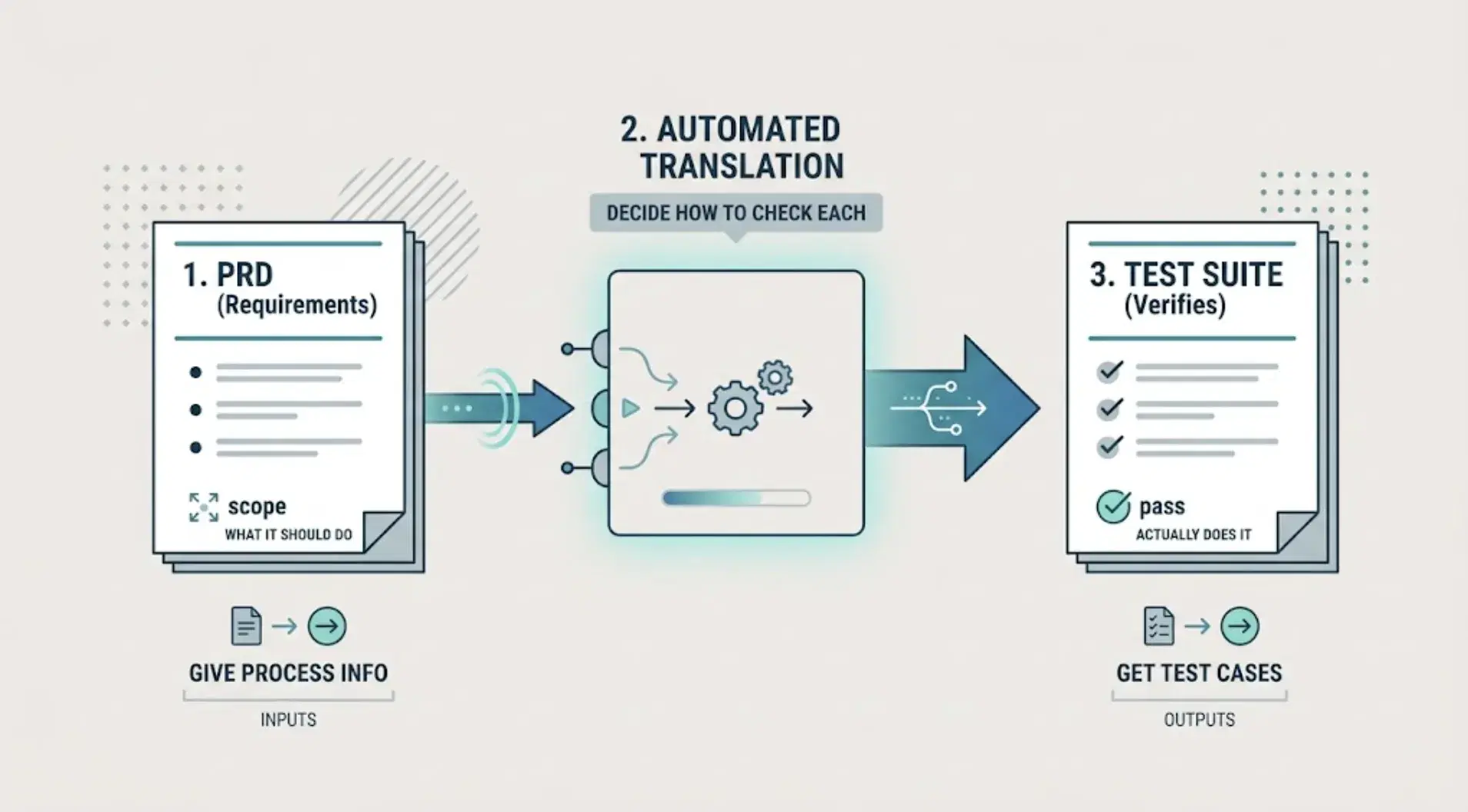
A PRD describes what your product should do. A test suite verifies that it actually does it. Between those two documents sits a translation step that, historically, only a human could do: reading requirements and deciding how to check each one. Here's how that translation happens automatically, and what to actually give the process to get good results.
Why this translation step usually breaks down
In a traditional workflow, someone (a QA engineer, or a developer wearing that hat) reads the PRD, breaks it into testable requirements, and writes test cases for each one. That works when there's time and a person assigned to do it. It breaks down for exactly the reason a lot of AI-native teams are feeling right now: the PRD gets written or updated faster than anyone has time to re-derive test coverage from it, especially once an AI coding agent starts shipping against it at a pace no manual QA process was designed for.
The result is a familiar pattern: the PRD says what should happen, the code does something slightly different, and nothing catches the gap because nobody translated the requirement into an actual check.
What "automatically" means here, specifically
An agent that's PRD-driven reads your requirements document directly and builds a normalized internal version of it, structured consistently regardless of your original PRD's format, whether that's a formal spec, a rough Notion doc, or a handful of user stories. From that normalized PRD, it generates test cases that map to the actual requirements, rather than to whatever a person happened to notice while skimming the document.
The practical process
1. Upload or point to your existing PRD. If you have one, in whatever format it's currently in, that becomes the primary source of intent. You don't need to reformat it first; the normalization step handles translating your existing structure into something the testing agent can work from consistently.
2. Let the agent build a normalized requirements document. This step combines your PRD with an analysis of your actual codebase: project structure, component hierarchy, API routes, and implementation patterns. The result is a structured internal PRD with components like product overview, goals, and requirements broken out clearly enough to map to individual test cases.
3. Review the test plan before execution, not after. This is the step worth not skipping. The generated plan will show you which requirements got mapped to which test cases, and this is your chance to catch a misread requirement before it turns into wasted test runs, not after you're staring at a report wondering why a passing test doesn't match what you actually meant.
4. Let test case generation and code generation happen from the reviewed plan. Once the plan looks right, the agent designs test cases covering happy paths, edge cases, and error states for each requirement, then writes the actual executable scripts (Playwright, Cypress, or API test scripts depending on your project) without you touching test code directly.
5. Execute in an isolated environment and read the results against your original PRD, not just against pass/fail. A test passing doesn't automatically mean the requirement it maps to was satisfied correctly; it's worth spot-checking the mapping between test cases and PRD sections periodically, especially early on, to build confidence that the translation step is capturing intent accurately.
What to actually put in your PRD to get better results
The quality of generated tests tracks the quality and specificity of your PRD. A requirement written as "users can check out" gives an agent less to work with than "users can check out with a saved card, a new card, or PayPal, and see an error if the payment fails." The second version maps directly to distinct test cases (three payment methods, one failure state) that the first version leaves the agent to guess at.
If you don't have a formal PRD at all, that's not a blocker, an agent can reverse-engineer product intent directly from your codebase. But a written PRD, even an informal one, consistently produces more precisely targeted test coverage than pure code inference, since code shows you what was built, not necessarily what was intended.
What this changes about how you write PRDs going forward
Once you know a PRD feeds test generation directly, it's worth writing requirements with testable specificity in mind: naming distinct states and edge cases explicitly, rather than describing a feature only at a high level and assuming the details get filled in during implementation. This isn't extra work for its own sake; it's the same specificity a competent QA engineer would have asked you for anyway, just captured upfront instead of extracted through a review meeting later.
A habit worth building: updating the PRD before updating the code
The temptation, especially when moving fast with an AI coding agent, is to change the implementation first and update the PRD later, if at all. That ordering quietly breaks the whole premise of PRD-driven testing, since the generated tests will keep verifying the old requirement until someone remembers to update the document. Flipping the order, updating the PRD first, even by a sentence, before asking your coding agent to implement the change, keeps your test generation anchored to your current intent rather than trailing behind it. It also has a secondary benefit: a coding agent working from an updated requirement tends to produce a more accurate implementation than one working from a requirement that's already stale by the time it starts.
A short example of the difference specificity makes
Compare two versions of the same requirement. "Users can reset their password" tells a test generator almost nothing beyond the existence of a reset flow. "Users request a reset link by email, the link expires after 30 minutes, and an expired link shows a specific error rather than a generic failure" gives the generator three distinct, testable behaviors instead of one vague one: the request itself, the expiration boundary, and the specific error state. The second version takes maybe fifteen extra seconds to write, and it's the difference between a test suite that checks whether a feature exists and one that checks whether it actually behaves the way you intended at the edges, which is where most real bugs live in practice.
Conclusion
Turning a PRD into executable tests automatically removes the manual translation step that usually becomes the bottleneck once AI accelerates everything else in the pipeline. The requirement still needs to be clear; what changes is who does the work of turning that requirement into a running test. TestSprite's PRD-driven test generation handles that translation directly from your existing requirements document, formal or informal.